Preprint · Zenodo · November 2026
Validated Personal Memory for Language Models: A Bounded Study of State Correctness, Answer Reliability, and Processing Cost
Designed and evaluated personal-memory middleware for language models, measuring state correctness, answer reliability and processing cost across nine approaches.
01 / Problem and approach
The problem
How can an assistant maintain changing personal facts, preserve history, respect declined updates and logically forget records? How do correct stored states relate to correct answers and processing cost?
My contribution
Designed structured personal-memory middleware with proposed operations, staged execution and explicit acceptance. Implemented SQLite records, compared history, summarisation and retrieval approaches, and prepared the manuscript and supporting analyses.
System architecture
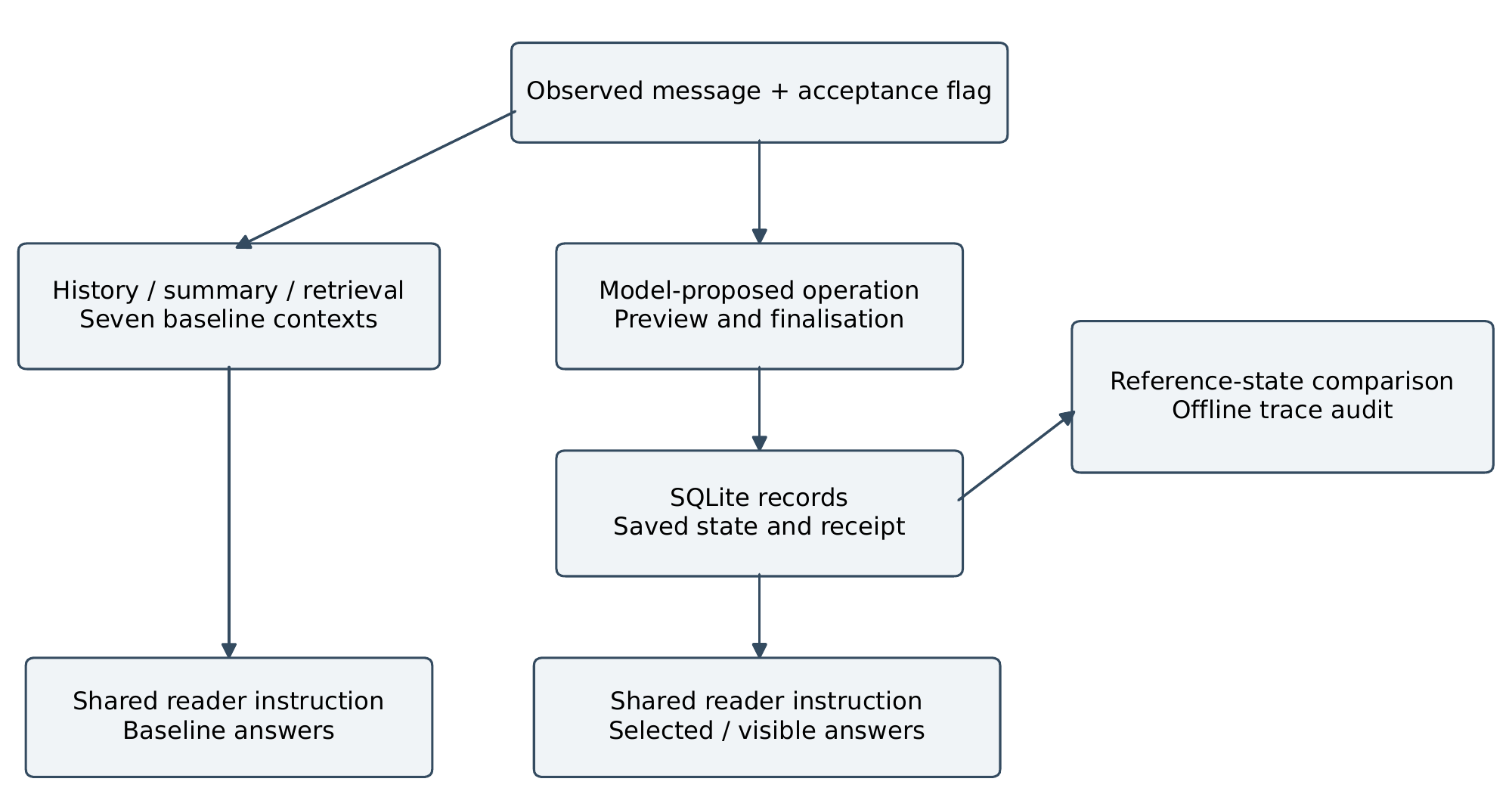
The study separates saved-state validation from answer generation. Seven baseline contexts are compared with selected-record and all-visible-record approaches using shared reader instructions.
02 / Evaluation and evidence
- Authored middleware comparison: nine methods, three model configurations and 1,620 answer outputs.
- All 486 saved state-transition traces matched their reference states.
- All-visible records: 60/60 exact answers for each model. Selected records: DeepSeek 60/60, Gemma 60/60 and GLM 57/60.
- Selected-record memory used 19.0-26.4% more total model tokens than full history when interpretation was included.
- Separate model-only analysis: 82,972 saved answers across adapted RULER, LongMemEval-S and LoCoMo-QA. These runs did not evaluate the middleware.
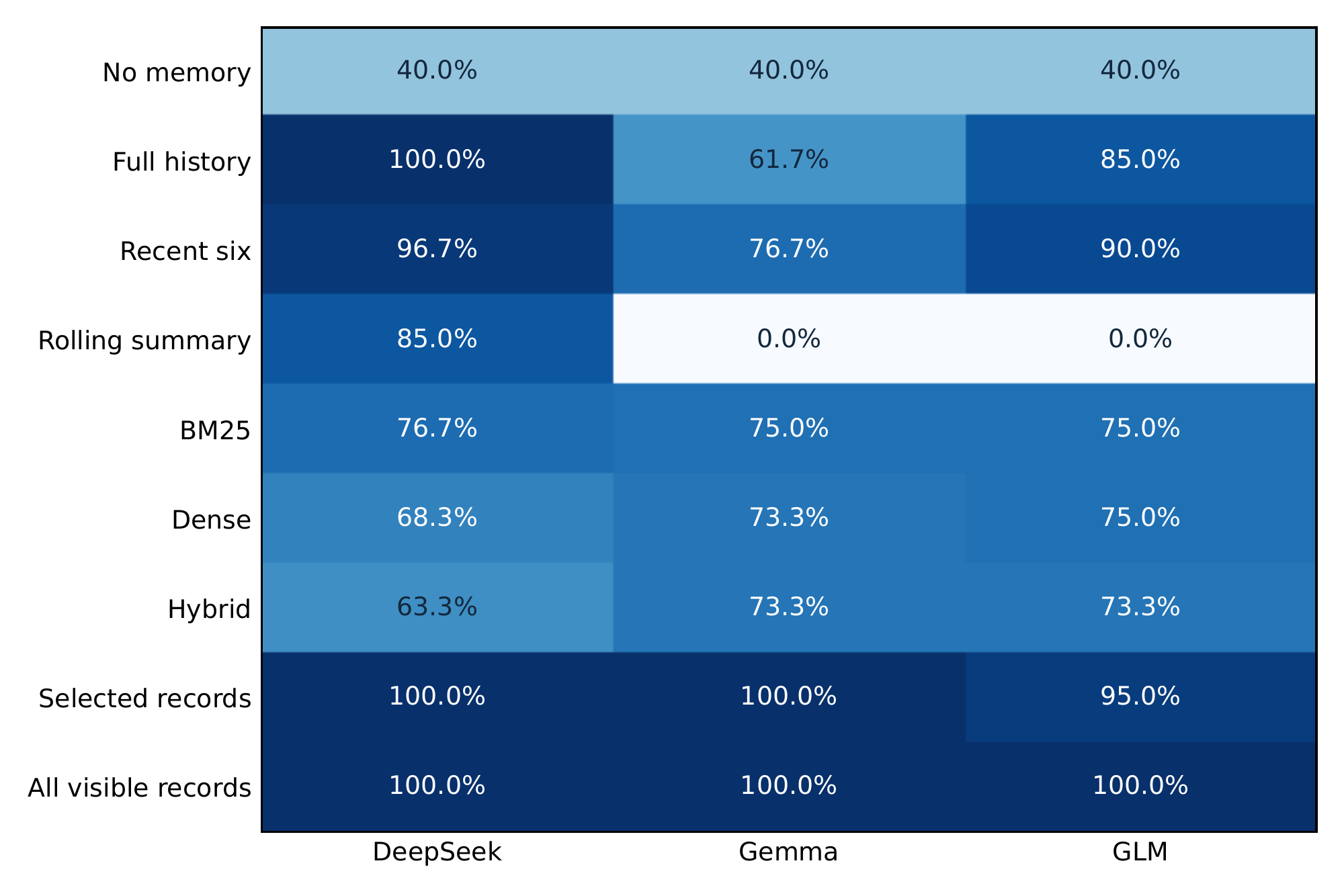
Results from the bounded study, not a general model-accuracy claim. All-visible records reached 60/60 answers in each model configuration; selected records reached 60/60 for DeepSeek and Gemma, and 57/60 for GLM. Answer accuracy is distinct from saved-state correctness.
03 / Scope and context
Scope and limitations
Published preprint, not peer-reviewed. The authored workload is bounded and synthetic; it does not establish general conversational reliability. Memory lives in external structured storage and does not update model weights. The public repository reproduces released score analyses, not the complete middleware or full end-to-end experiments. The earlier acceptance study retains one failed supported case.
Project chronology
Earlier neural-memory experiments preceded this study. Published on 14 November 2026; this is a publication milestone, not the research start date.